Spatially resolved transcriptomics: An introductory overview of spatial gene expression profiling methods
Spatially transcriptomics is crucial for understanding how cell location influences gene expression, development, and disease. This field has evolved from early techniques like radioactive in situ hybridization to advanced methods such as sequencing-based Visium Spatial and imaging-based Xenium In Situ. These technologies allow researchers to analyze gene expression within the natural cellular context, revealing new biological insights across various fields, including developmental biology, cancer, and neuroscience. Choosing the right method depends on research goals, with sequencing-based methods suited for hypothesis generation and imaging-based methods for detailed hypothesis testing and specific target analysis.
Optimizing your spatial transcriptomics research with Visium HD and Xenium In Situ
Spatial transcriptomics, a revolutionary technique that unveils gene activity within tissues, is transforming biological research. 10x Genomics offers two powerful solutions, Visium HD and Xenium In Situ, that provide a more holistic view of gene expression. Visium HD analyzes the entire transcriptome across large areas, making it ideal for initial discovery. Xenium In Situ, on the other hand, focuses on a targeted set of genes with exceptional resolution, perfect for validating prior findings. By using these complementary methods together, researchers can unlock a deeper understanding of gene expression within tissues. 
A more precise way to find the needle in the haystack: Identifying rare biology with Xenium In Situ
Understanding tumor invasiveness is challenging due to subtle heterogeneity. The Xenium In Situ platform from 10x Genomics integrates single-cell resolution with spatial gene expression to uncover detailed heterogeneity in tumors. In a breast cancer study, it identified a rare triple-positive region (HER2+/ER+/PR+), crucial for prognosis and treatment. Xenium uses high-sensitivity padlock probes to create a spatial map of transcripts at subcellular resolution and preserves tissue for further analysis. This powerful tool enhances cancer research by providing comprehensive molecular insights and improving diagnostic and treatment strategies.
See tissue complexity in a new light with simultaneous gene and protein spatial profiling
With Visium's high-resolution spatial capture technology and intuitive software, researchers can visualize gene and protein expression like never before. From understanding cellular dynamics to deciphering disease mechanisms, Visium empowers researchers across diverse fields to embark on a journey of discovery, uncovering the secrets of tissue biology and disease pathology with style and precision.
In situ detection and subcellular localization of 5,000 genes using Xenium Analyzer
The impressive capabilities of the 10x Genomics 5,000-plex human gene expression panel were demonstrated using the Xenium Analyzer system, which successfully imaged a total area of 420 mm² over 124 hours. A deep analysis of a human liver sample slide revealed an average of 408 transcripts per cell across 1,018,026 cells, with a low false discovery rate of just 0.3%. This detailed examination identified 26 distinct cell types and five unique spatial niches, confirmed by visualizing marker genes for accurate cell type and neighborhood assignments. The 5,000-plex panel offers comprehensive coverage, making it an excellent tool for classifying cell types, exploring drug target interactions, investigating cell-cell signaling, and mapping biological pathways across all human tissues.
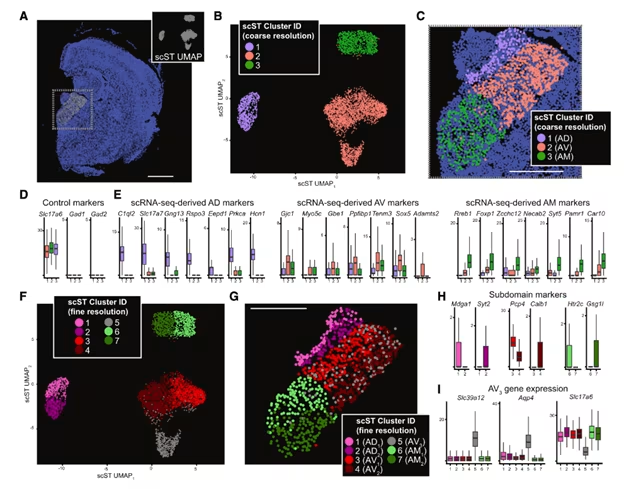
Spatial transcriptomics is transforming cancer research by enabling detailed analysis of tumor complexity while preserving natural cell interactions. This innovative technique allows researchers to visualize gene expression patterns within the tumor microenvironment, uncovering interactions between different cell types and surrounding structures such as blood vessels and immune cells. By integrating spatial transcriptomics with advanced computational tools, scientists can identify biomarkers, map signaling pathways, and understand how these factors influence treatment response and resistance. This approach holds great promise for advancing personalized medicine in oncology, facilitating the development of targeted therapies tailored to individual patients based on their unique tumor biology.
Some of our favourite Visium spatial transcriptomics publications from 2023
Looking back on 2023, we’re amazed and humbled to see the profound impact of Visium Spatial technology across a range of pioneering research endeavours. From uncovering novel T-cell states in cancer to deciphering genes crucial for palate development, each publication exemplifies Visium’s capacity to unveil spatially resolved, whole-transcriptome insights that redefine our understanding of complex biological processes. These studies not only highlight the power of unbiased spatial analysis but also underscore Visium’s role in advancing biomedical research by enabling new discoveries and therapeutic possibilities.
Menu Ẩn